
How to choose a sanitary pad vending machine for a school
Key takeaways
- Start with who pays. That decides the payment method more than any feature list does.
- RFID cards let a school give pads to students who cannot pay, without handling cash.
- Choose a steel body, a stock display and a battery backup. Ask who will refill it, and how often.
- A machine nobody maintains is worse than none, so name a person before you buy.
On this page
A school can buy a pad vending machine in an afternoon and regret it in a month. The usual reason is not the machine. It is that nobody decided who pays, who refills it and who fixes it. Work through these questions first.
1. Who pays?
This decides almost everything else.
- Students pay. Coins or notes work. Set the price near the cost of the pad so stock can be replaced.
- The school pays. Use RFID cards or a push button, so students take a pad without paying. The school tops up the stock.
- A mix. Preloaded cards are the flexible answer. The school can give cards to students who cannot pay, and others can pay in cash.
For an example of pricing, a scheme in Thiruvananthapuram, India sold a packet of three napkins for Rs 10 from school machines and made the first 500 packets from each machine free.
2. How will they pay?
| Method | Works best when | Watch out for |
|---|---|---|
| Coins | Small prices, no power or network | Carrying coins, jams |
| Cash notes | Higher prices, public places | Cleaning, worn notes |
| RFID card | A closed group such as a school | Issuing and topping up cards |
| QR code | Busy public places with signal | No network, no sale |
3. Is the body strong enough?
School machines are kicked, shaken and written on. Look for heavy steel with a powder-coated finish, a locked cash box and a front panel that cannot be pried off.
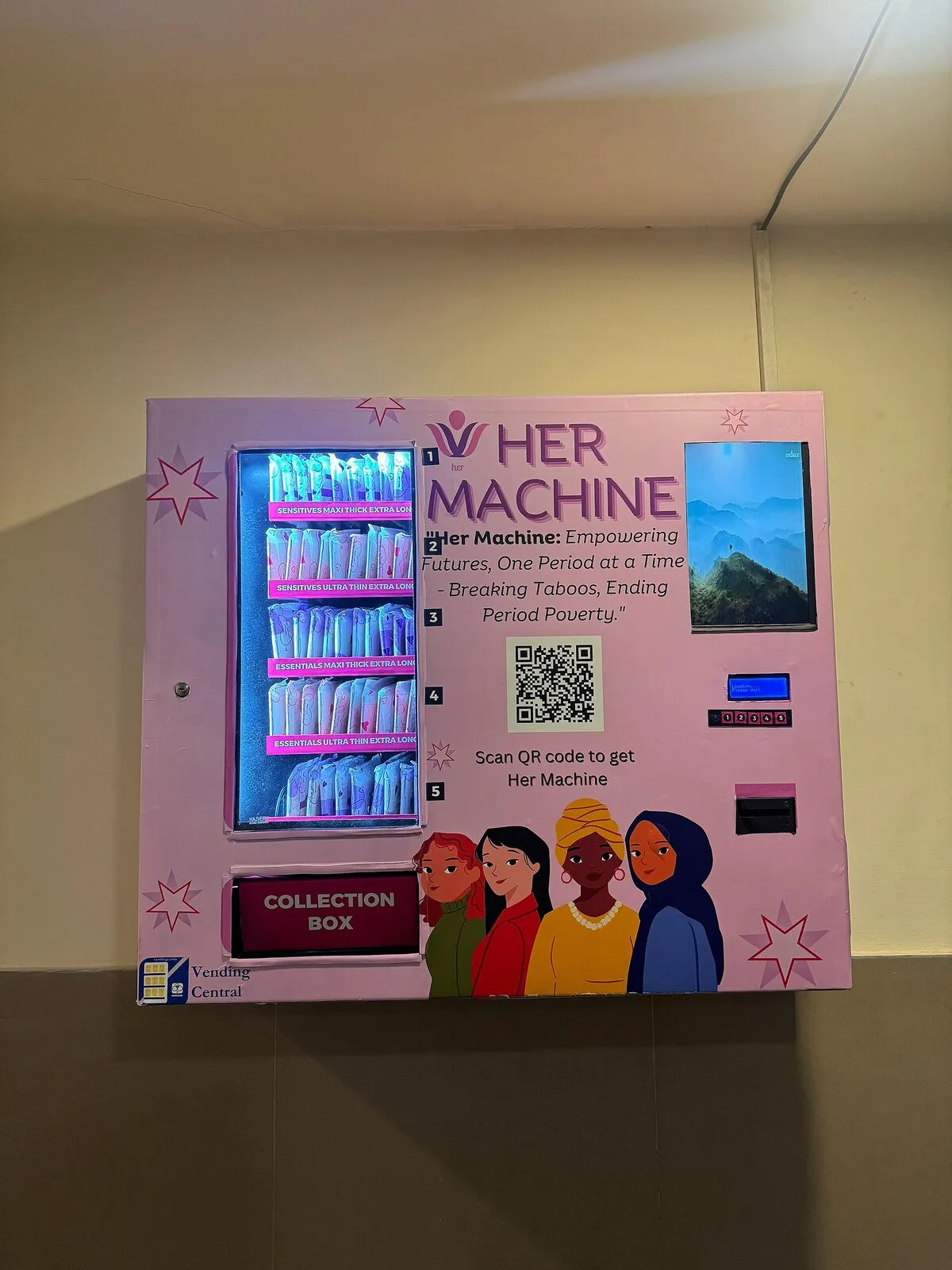
4. Does it show stock and stop when empty?
A display that shows price and stock saves students from paying for a pad that is not there. Check that the machine stops taking money when empty or when its cash box is full.
5. What happens in a power cut?
A battery backup keeps the machine alive through load-shedding. Ask how many hours it lasts and how it recharges.
6. Where will it go, and who will refill it?
Put it inside the girls’ toilet block or in a private lobby next to it, near a power point and away from damp. Then name a person to refill it and empty the cash box, and agree how often. The same person should log every refill. Our guide to where to put a machine and a bin covers placement in more detail.
7. What about spare parts and support?
Ask where the maker is, how fast they can come, and whether they sell spare coin mechanisms, note validators and shelf parts. A machine made in the same country as the school is easier to repair than one that must be sent abroad.
Questions people ask
How many machines does a school need?
Start with one in each girls’ toilet block, and add more where queues form or where blocks are far apart. Ask the maker to size the shelf for your number of students.
Should the machine be free or paid?
Either works. A paid machine recovers the cost of pads and keeps stock going. A free machine, or one that takes preloaded cards, reaches students who cannot pay. Many schools combine them with cards.
Who should hold the key?
One named teacher or staff member, with a second person as backup. The key holder refills, empties the cash box and logs both.
Image credits
- “School toilet (7829736488)” by SuSanA Secretariat, CC BY 2.0. Resized and cropped.
- “Image of her machine Pakistan our” by Zubairkhalid1984, CC BY-SA 4.0. Resized.

